Gua Sha
Gua sha is a traditional East Asian practice that uses a smooth-edged tool to press and stroke lubricated skin in one direction. It appears in the World Health Organization’s standard terminology for traditional Chinese medicine. Inclusion in a terminology standard does not prove a beauty or health benefit.
The name now also appears on gentle facial tools used with much lighter pressure. Traditional scraping and modern facial gua sha share a name, but they don’t use the same intensity or aim for the same skin response.
Meaning and traditional practice
Gua refers to scraping or rubbing. Sha refers to the red dots or broader red patches that may appear on the skin. In traditional practice, a rounded tool is pressed over lubricated skin in repeated, one-way strokes.
Traditional gua sha may intentionally produce petechiae or ecchymosis, which are small spots or wider patches of bleeding beneath the skin. These marks aren’t toxins leaving the body. Pressure causes a small amount of blood to move out of superficial vessels and into the surrounding tissue.
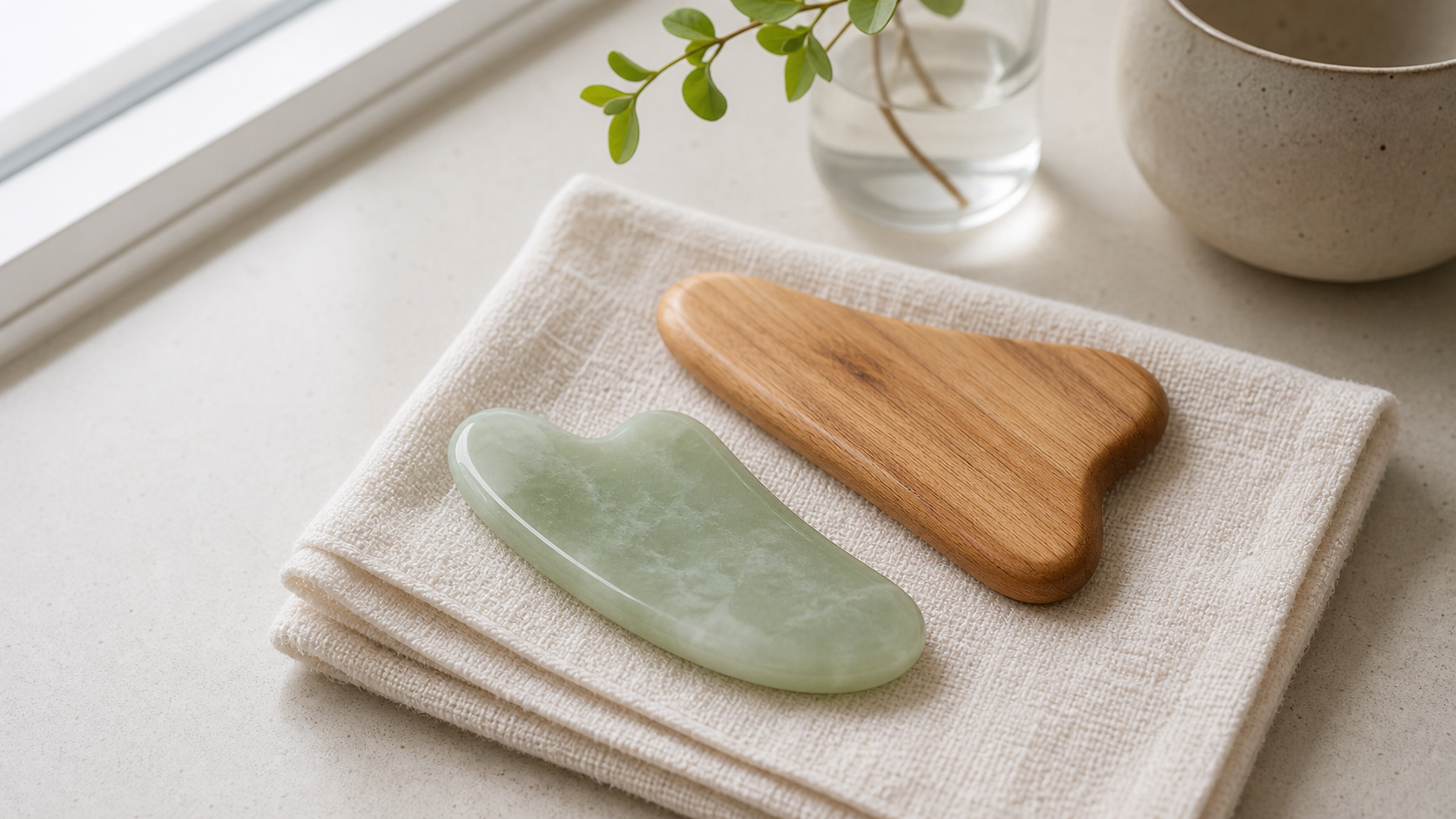
Traditional and facial gua sha
The tools can look similar, but the pressure and intended skin response differ.
- Traditional gua sha: Repeated one-way strokes intentionally bring up red dots and patches.
- Facial gua sha: Beauty tools for the face and neck are commonly used with light pressure. They shouldn’t copy the intensity used to bring up sha in traditional body scraping.
A product labeled gua sha doesn’t come with one universal method. Face, scalp, and body tools vary in size and edge shape, and brands give different instructions.
Tools and red marks
Gua sha tools may be made from horn, jade, wood, ceramic, metal, or resin. The material matters less than a smooth, undamaged edge and whether the tool can be cleaned properly.
Traditional scraping may leave spots or marks that resemble bruising. Darker marks don’t show that a session worked better. If blood reaches the skin surface, the tool can become contaminated and shouldn’t be shared.
Limits of the research
Small studies have measured short-term changes in local skin temperature and blood flow after scraping. Those findings don’t prove that gua sha reduces swelling, makes a face smaller, or treats a health condition.
Claims about lymph flow, detoxification, or removing stagnant blood go beyond the evidence for cosmetic results. A clearer question is how much pressure will be used, on which area, and with what hygiene steps.
Gua sha and manual massage
- Gua sha: A firm tool presses and moves across the skin.
- Manual massage: A broad label for care in which a therapist uses their hands to touch, press, and knead.
Meccrom doesn’t use gua sha tools. Its sessions center on direct contact with the hands, with the area and pressure adjusted during the session.
Frequently asked questions
Do red marks have to appear after gua sha? Traditional gua sha intentionally produces red spots and patches. Gentle facial gua sha doesn’t aim for the same marks.
Does stronger pressure make gua sha more effective? No. More pressure can increase petechiae, bruising, and skin injury. Pressure should match the body area and the instructions for the tool.
Can I get gua sha at Meccrom? Meccrom doesn’t use gua sha tools. Its esthetic care is done by hand.