Gyeongrak Massage
Gyeongrak massage is a Korean esthetic service that borrows the traditional meridian concept for hands-on face or body care. Gyeongrak is the theory. Gyeongrak massage is an industry label for a service.
There isn’t one international protocol that fixes every movement or step. Two businesses can use the same name while offering different working areas, pressure, products, and tools.
Meaning and status
The World Health Organization’s traditional medicine terminology includes meridians, acupuncture points, acupuncture, and moxibustion. Gyeongrak massage doesn’t appear there as a separately standardized treatment. It’s better understood as a Korean beauty-industry term that brings traditional language into a hands-on menu.
It sits within the broad category of manual care, with the gyeongrak framework added to explain the therapist’s working lines or order. A full-body service may be called gyeongrak massage, while a face-focused version may be listed as face gyeongrak or facial meridian massage.
Working areas and movements
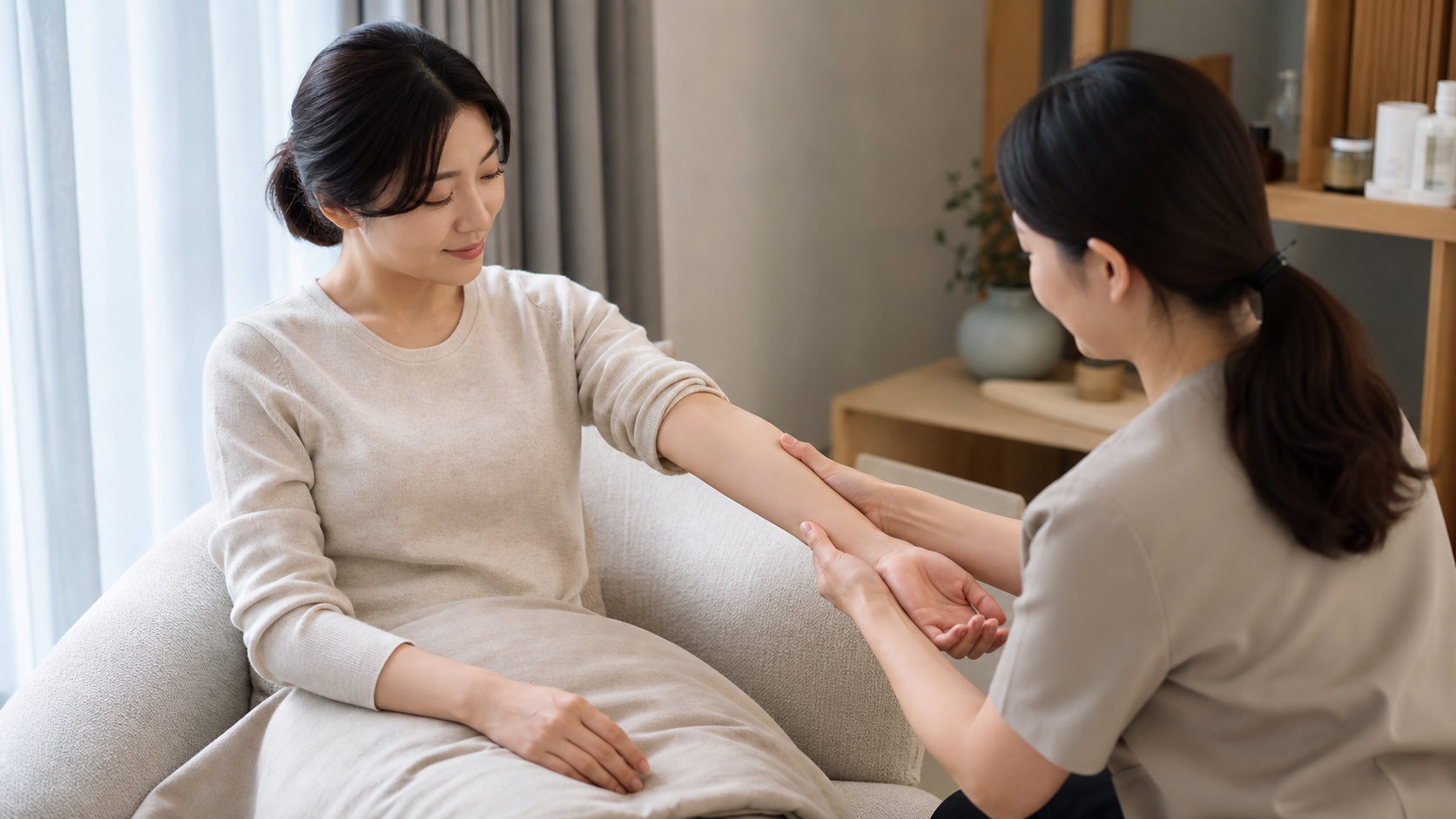
The menu name alone doesn’t tell you exactly what happens. A session may combine several elements, depending on the business.
- Pressing or gliding movements with the palms and fingers
- A defined area such as the face, neck, shoulders, or back
- Oil or cream to reduce friction on the skin
- Adjustments to pressure and pace as the client responds
Some services describe their movements as pressing acupuncture points. That doesn’t make the service the same as acupuncture or moxibustion. Inserting a needle or applying heat is materially different from working on the skin by hand.
Gyeongrak massage and related methods
| Term | Meaning | What to check |
|---|---|---|
| Gyeongrak | A concept in traditional East Asian medicine | It isn’t a massage by itself |
| Gyeongrak massage | An industry label for hands-on care | There is no single protocol, so check the actual service |
| Face gyeongrak | A face-focused gyeongrak-style program | Some sessions include the neck and shoulders, while others don’t |
| Acupuncture | A practice that stimulates selected points with fine needles | The method is different from hands-on esthetic care |
Similar names don’t establish the same training, purpose, or result.
Limits of effect claims
Marketing descriptions may say the service opens meridians, removes toxins, corrects the skeleton, or makes the face smaller. Those claims don’t follow from the menu name. A meridian isn’t an anatomical tube, and hand pressure doesn’t reshape facial bones or body structure.
Touch around the skin and muscles may feel relaxing during a session. That experience can change with the pressure, session length, and condition of your skin. Gyeongrak massage shouldn’t be presented as treatment for a disease or persistent pain.
Before a session
Ask what the service actually includes instead of relying on the name.
- Which areas are worked on, and for how long
- Whether the session uses only the hands or also includes tools or devices
- How much the pressure can be adjusted
- What the business does when skin is irritated or broken
Pain isn’t a measure of quality. Ask for lighter pressure if you feel pain, tingling, or strong pulling on the skin. Broken or inflamed skin and persistent pain need appropriate health care, not more pressure.
Related terms
- Gyeongrak: The East Asian medicine concept that brings meridians and their smaller branches together.
- Face gyeongrak: A face-focused esthetic service in the gyeongrak family.
- Manual massage: A broad industry term for care performed mainly by hand.
Frequently asked questions
Is gyeongrak massage a standardized technique? No. It’s a familiar service name in the Korean beauty industry, but there isn’t one fixed sequence that every business must follow.
Is it the same as acupuncture? No. Both may refer to the traditional meridian concept, but acupuncture inserts fine needles through the skin. Gyeongrak massage works on the skin and surrounding soft tissue by hand.
Does stronger pressure change the face or body more? There’s no basis for treating pain as proof that bone or body structure is changing. Ask the therapist to ease up when pressure hurts.
This glossary entry is for general information. Experiences vary, and esthetic care isn’t intended to prevent or treat a condition.